Climate change is here. Scientists agree. Period. The debate is only about the details. The question now is: How will we live a decade from now, or a century, or a millennium? Will our species survive?
As a writer of speculative fiction, I’m interested in how humans will adapt to a new world where average temperatures are as many as six degrees above the historical average, according to current scientific predictions. Even predictions on the low end will likely result in massive disruptions of life on planet Earth, including human life.
A new genre of science fiction is emerging that puts climate change center stage. It goes by different names, including “climate fiction,” “cli-fi,” and “eco-fiction.” I see the niche as a continuation of the apocalyptic tradition of literature, which asks, what will the end of the world be like?
As I’ve explored a future ravaged by global warming, I’ve tried to follow some simple rules that help me keep climate change in mind as I invent characters and imagine societies.
Climate change is the driving force behind the narrative. The impact of long-term change in the earth’s climate is the single most important factor distinguishing climate fiction from other genres. Put another way, the absence of long-term climate trends would render an otherwise well-constructed story meaningless or confusing.
It’s important to remember the difference between weather and climate. Weather happens over a short period of time. Climate happens over a long period of time, e.g., decades or centuries. Stories that depend on a specific weather event, such as a tornado or hurricane, don’t qualify as climate fiction, unless the narrative makes clear that the weather event is closely tied to long-term climate change. For example, the story of Noah’s Ark is not climate fiction, because the Biblical Flood was a single, one-time, divinely caused disaster, not the result of long-term climate trends.
Understanding climate change within the story depends on science. Climate fiction is rooted in science fiction; think of cli-fi as an outgrowth of sci-fi. As such, climate fiction works best when the change driving the narrative is based on established science, or at least speculation that stems from science. A writer could base a climate fiction novel or short on the scientific consensus, or on a minority viewpoint. But facts derived via the scientific method are key. A story that posits an impossible effect of climate change is not climate fiction. For example, the 2013 schlock motion picture Sharknado linked a weather event spawning flying sharks to climate change. This is patently impossible, and therefore Sharknado is not climate fiction.
Climate fiction happens on earth, mostly. From a scientific perspective, climate happens on any celestial body with an atmosphere. The planet Mars has a climate, as does Venus. Many scientists view Venus’ climate as a model for runaway greenhouse effects. And theoretically, a writer could set a climate fiction story on a distant world facing a climate disaster, or in the case of Kim Stanley Robinson’s Mars trilogy, an upgrade. But a hallmark of most cli-fi stories is the exploration of the potential impact of climate change on human societies, and we only know of one: on Earth. Unless the writer NEEDS to place her climate change story on a non-earth world, it’s probably best to make Terra the setting.
 Writers do not have to label work as climate fiction for it to qualify as such. The term “climate fiction” goes back to 2008, when activist and public relations man Dan Bloom first suggested it as a way to classify certain climate-based stories. Several dozen books and movies (no plays or poetry that I know of) have received the label. Of course, writers working before 2008 would not have used the term. (One of the earliest identified climate fiction novels, The Drowned World, was published in 1962.) At present, the term is not widely accepted in the literary community, so writers probably shouldn’t use it when pitching new work to agents or publishers. Maybe someday…
Keep your political views on climate change to yourself. The history of literature is filled with authors who change public policy with exceptionally crafted fiction. Charles Dickens highlighted the poverty of mid-19th century London in Oliver Twist and other novels. Upton Sinclair’s The Jungle exposed conditions in early 20th-century meat-packing plants. But most authors avoid this approach, because it’s very difficult to do so without appearing preachy or dogmatic. In the case of climate fiction, a writer may create a character who discovers, for example, that climate science is a hoax. It’s the writer’s job to convince readers that characters perpetrating the hoax are plausible without coming across as thoughtless deniers. Good luck with that.
Like all other fiction, climate fiction has no rules. Experienced writers will tell you that fiction has no rules for success, though various guidelines or best practices are useful, such as the familiar “show, don’t tell.” Climate fiction is no different. For example, 95 percent or more of climate fiction is dystopian. Cli-fi usually assumes that climate change is detrimental to human societies, often wiping out civilization as we know it. However, at least one recent climate fiction novel, Jonathon Porritt’s The World We Made, presents a utopian view of human reaction to climate change. In this book’s future, societies thrive and the environment is saved. In other words, fiction rules are made to be broken. If you break the rules, be smart about it.
The potential real world effects of climate change are frightening, but they also present fascinating opportunities for storytelling. Any author, not just science fiction authors, should consider the climate when inventing future societies and conditions on Earth.
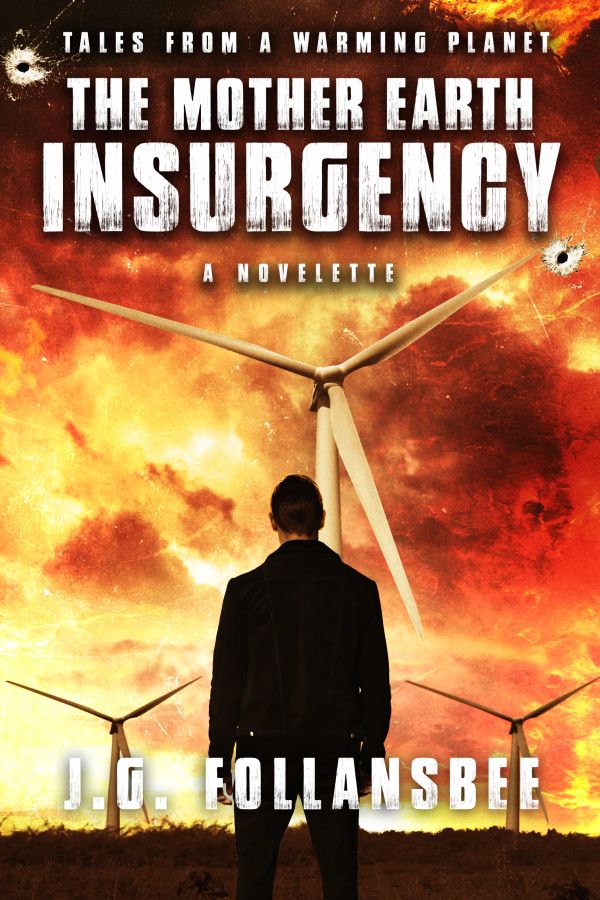
J.G. Follansbee is author of the ongoing series Tales From A Warming Planet, including the novelette The Mother Earth Insurgency and Carbon Run. He blogs at http://jgfollansbee.com. You can follow him on Facebook (@AuthorJGFollansbee), Twitter (@Joe_Follansbee), and Instagram (@jgfollansbee).