Randy continues our countdown to Hallowe’en 2013 with a double bill of classic Horror stories.
“LONGTOOTH” by Edgar Pangborn (From Good Neighbors and Other Strangers; included in Foundations of Fear edited by David Hartwell)
My word is good. How can I prove it? Born in Darkfield, wasn’t I? Stayed away more years after college, but when I returned I was still Ben Dane, one of the Darkfield Danes, Judge Marcus Dane’s eldest. And they knew my word was good. My wife died and I sickened of all cities; then my bachelor brother Sam died too, who’d lived all his life here in Darkfield, running his one-man law office over in Lohman – our nearest metropolis, population 6,437. A fast coronary at fifty; I had loved him. Helen gone, then Sam – I wound up my unimportances and came home, inheriting Sam’s housekeeper Adelaide Simmons, her grim stability and celestial cooking. Nostalgia for Maine is a serious matter, late in life: I had to yield. I expected a gradual drift into my childless old age playing correspondence chess, translating a few of the classics. I thought I could take for granted the continued respect of my neighbors. I say my word is good.– first paragraphIt’s strange to pair Pangborn’s name with the word “horror.” Pangborn was a compassionate and empathetic writer, more inclined to gentle humor and a contemplation of good will and how sometimes good will isn’t enough. And that’s all true of this novella, but “Longtooth” is also a horror story.
Harp is married to Leda. At 56 Harp is old — the story was published in 1970 and estimates of the number of years constituting old were a bit more conservative before the first wave of Baby Boomers ripened enough to insist “old” extend outward — and Leda is 28. Ben, our narrator, has renewed his friendship with Harp since returning to Darkfield. A year older and less healthy than Harp, Ben already notes the effects of a failing heart and lungs weakened by heavy smoking, and feeling the effects of age more acutely is inclined to ponder the discrepancy in age between his friend and his wife. Others in town have also wondered on a young woman’s reasons for marrying a man so much her elder, but not in front of Harp: Apparently Harp isn’t so old that they dare.
At the beginning of “Longtooth” Ben visits Harp to bring him a book. Snowed in, Ben and Harp talk and Harp confides in Ben that over the brutal Maine winter he has heard noises off in the woods around his house. The previous Fall one of his cows had been killed after a crossbeam of the fence had been pulled out – not pried, not broken, but pulled apart – and the cow led off into the woods before being slaughtered and eaten raw. Harp is an experienced woodsman but can’t find the trail of the killer; he suspects it reaches the woods and travels tree to tree. Ben wonders about Harp and the pressure on an aging man of a young wife, even if his every move and glance at Leda is filled with adoration. But then Ben hears the sounds, too, and even sees the shadow of the thing, and while Harp and Ben are busy with the livestock, something crashes in Leda’s bedroom, and when they reach the bedroom they find the window broken inward and Leda gone.
The town officials are more than skeptical, and so Ben and Harp are on their own to find the truth, and the truth … well, truth can be devastating.
Pangborn was a stylist, not as showy as Ray Bradbury or Cordwainer Smith often were, but with a distinct, often wry way of expressing himself. On the beginning of the snow storm, “I saw the midget devils of white running crazy down a huge slope of wind …” On Harp and his home, “He produced a difficult granite smile, maybe using up his allowance for the week, and pulled out a bottle from a cabinet that had stood for many years below a parlor print – George Washington, I think, concluding a treaty with some offbeat sufferer from hepatitis who may have been General Cornwallis if the latter had two left feet.”
And throughout Pangborn sets his scene neatly and concisely often, as when Ben and Harp track Longtooth, tying description to perspective, “It was a region of uniform old growth, mostly hemlock, no recent lumbering, few landmarks. The monotony wore down native patience to a numbness, and our snowshoes left no more impression than did our thoughts.”
“Longtooth” examines aging — in this it might make an interesting companion read with Bradbury’s Something Wicked This Way Comes — and the effects on a man of losing his wife, of losing the trust of his community and maybe of losing his self-confidence. If “Longtooth” doesn’t reach the pitch of terror of other outdoor stories like Algernon Blackwood’s “The Willows,” it postulates a sort of “call of the wild” (I suspect Pangborn chose the name Leda purposely) and applies the decency innate in all of Pangborn’s work to a melancholy and sad effect, reminding us dread does not issue solely from the thing in the night.
Other horror by Pangborn: “A Better Mousehole” (same story collection)
RELATED READING:
”The Autopsy” by Michael SheaAnd probably much easier to find …
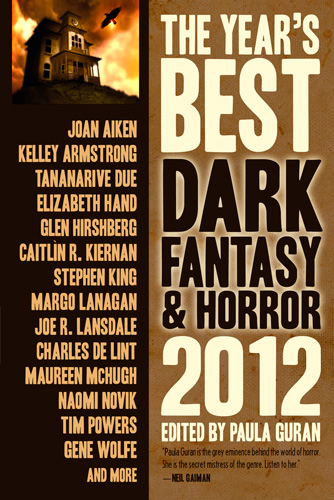
“NEAR ZENNOR” by Elizabeth Hand (A Book of Horrors ed. Stephen Jones, St.Martin’s Griffin, 2012; Errantry, 2012; The Year’s Best Dark Fantasy and Horror, ed. Paula Guran, 2011)
He found the letters inside a round metal candy tin, at the bottom of a plastic storage box in the garage, alongside strings of outdoor Christmas lights and various oddments his wife had saved for the yard sale she’d never managed to organize in almost thirty years of marriage. She’d died suddenly, shockingly, of a brain aneurysm, while planting daffodil bulbs the previous September.—first paragraph
Jeffrey, deep in mourning, is intrigued when he finds correspondence between his recently deceased wife, Anthea, and Robert Bennington, her favorite writer as a teenager, author of The Sun Battles, a series of YA novels Anthea and her friend, Evelyn, had loved as children, and which their other friend, Moira, had tolerated. Although Anthea had persuaded him to read them, Jeffrey did not take to the series the way she had, put off by the books’ darkness. The tenor of the correspondence, teenage adulation shading into anger and betrayal, lead Jeffrey to seek out Evelyn to learn more about the time the girls met with Bennington. The mystery only deepens when he finds that Bennington had later been accused, though never convicted, of sexual abuse of children, and Moira had disappeared shortly after the three girls met him.
In the afterward to this story Hand speaks of having visited Cornwall several times, and the fields, some of them merging with moor, all divided by stone walls and liable to be marshy, provide a distinctive setting. The burial mounds that dot the landscape intensify the weight of the past on the place and on the story, and the scene in which Jeffrey enters one opens up for him the possibilities of what Anthea and her friends experienced. In this, “Near Zennor” harks back to the work of Arthur Machen, Hand imbuing the prehistoric structures with a magic of their own which somehow cuts across time and connects our age with other times and a very different world.
For a reader looking to familiarize him or herself with weird fiction, this story would be a fine introduction since it is written in a fine contemporary prose and adroitly fuses the supernatural or paranormal to the human. The girls act like young girls, the older characters speak like people of their age group, and Jeffrey is a well-realized character whose grief comes across as real. Hand’s imagination is vivid and focused, her prose precise yet evocative, and she does not forget the human while exercising her inventiveness.
Other works of interest:
“Cleopatra Brimstone” by Elizabeth Hand (Saffron and Brimstone: Strange Stories; Poe’s Children edited by Peter Straub; The Mammoth Book of the Best of Best New Horror edited by Stephen Jones)
The Three Imposters by Arthur Machen (in particular “The Novel of the Black Seal”; more on this in a later entry)
The Complete Stories of M. R. James by M. R. James
Mythago Wood by Robert Holdstock
Midnight Sun by Ramsey CampbellNext Monday: The Ritual by Adam Nevill