In the past, people who wanted to write science fiction became philosophers. Today, people who want to write philosophy become science fiction authors.
Think about it: when Leibnitz was speculating about the best of all possible worlds, or More was writing Utopia, weren’t they really committing science fiction?
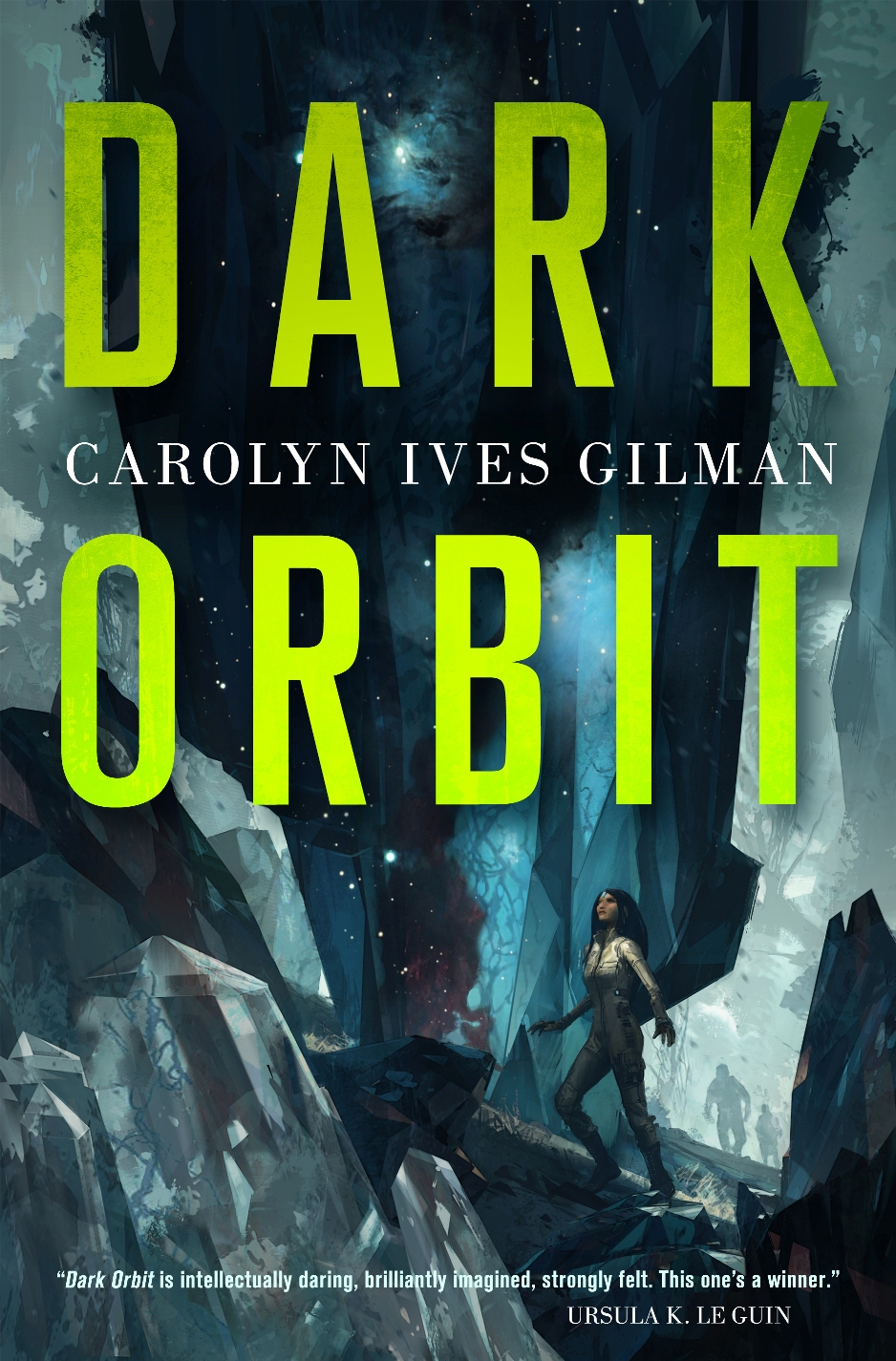
Nowadays, philosophy—like most of the humanities— has fallen onto hard times. There isn’t much consensus about its cultural value. If, like me, you want to think about the ultimate nature of reality, science fiction is a good place to go. That is one reason I wrote my latest novel, Dark Orbit. It is a story about a group of explorers marooned on a strange and dangerous world where they can’t come back alive without asking, how do we know what we know?
This by no means puts Dark Orbit outside the mainstream of science fiction. The classic science fiction authors of my childhood—people like Arthur C. Clarke, Fred Hoyle, Frank Herbert, and Robert Heinlein— didn’t shy away from the big questions. Our questions have changed, but our willingness to ask them should not.
Ever since that great science fiction writer René Descartes, we have divided our explanations of reality into two mutually exclusive realms, science and religion. I’m dissatisfied with them both, for different reasons.
Religion dissatisfies me because I am like one of thoseannoying kids who is always asking, “Why?” Religion is like one of those annoying parents who answer, “Because I said so.” When you question religion’s explanations of the universe, the answer is too often, trust me. Believe. I can’t give you evidence, but I’m right.
Science dissatisfies me because it is insufficiently ambitious. It has limited its definition of evidence to things that can be objectively verified and replicated. This leaves out vast areas of things we know to exist. Examples? Anything that can’t be observed is not evidence to science. Any occurrence that is unique is not evidence, because it can’t be replicated. Anything that can not be objectively perceived by more than one person is not evidence. This leaves out all subjective experience—things like pain, beauty, and transcendence.
Now, scientists generally don’t deny that unobservable, unique, and subjective phenomena are real; they just say they are outside the purview of science. Every now and then you get a rationalist crank who will say that the things science leaves out are not worth studying, but people like that tend to be on the gibbering fringe.
The problem that lies at the heart of Dark Orbit is this: essentially, just about everything is unobservable, unique, or subjective. My scientists come across one example after another.
- They go out to a new planet to study dark matter and dark energy—that 96% of the universe that can’t be observed, although we know it exists because of its gravitational effect on the 4% we can
- My explorers have a communicator that works through quantum entanglement. So their only way of phoning home tunnels through a level of reality where the act of observing affects the thing observed. Once a photon has been observed as a wave, it can never go back to being a particle. Until then, it existed in a mysterious way as both.
- When my characters land on the planet Iris, they find that even the act of observing is built on shaky ground. All evidence comes to us through our senses in the end, but the senses are subjective. We have no guarantee that what I experience as “blue” resembles what you see when you say “blue.” Iris turns out to be a place where what you see depends on where you’re standing and how you think.
So, what’s a scientist to do? My answer is not “give up.” Instead, the book makes a case for expanding science to embrace the unobservable, unique, and subjective. One of the Iris expedition members, who is dismissed as a madwoman and a crank by the empirical scientists, theorizes that our senses are actually bringing us more evidence than we realize. The five traditional senses come to us through the brain’s cortex, and we are therefore aware of them in a way that we are not aware of other senses we have. The senses that communicate not through the cortex, but through the inner brain, are subconscious, but they are there for a reason. We experience things like blindsight, premonition, intuition, revelation, and out-of-body existence not because we are deluded, but because these experiences are bringing us important information about the nature of ourselves and the world around us. To simply discount them without investigation is—well, unscientific.
We may have to invent new research methods that don’t rely on objectivity, measurement, and replication. The new research methods may superficially resemble those that mystics and visionaries have employed to break the hold that the five cortical senses have on our minds, but they will be far more rigorous. The real mystics (not the charlatans) are like researchers who go into the unknown and come back to tell us what they have observed. Up to now, they have often described their discoveries in culture-bound ways—in words like “god,” “collective unconscious,” or “samadhi.” But when you strip away the culturally determined parts and study the pure sensory reports, they tend to be remarkably consistent across cultures. The most familiar example is the sensation people interpret as a tunnel with light at the end. Another often-reported perception is of a vast and complex structure, variously interpreted. What these observations actually reflect, we can’t yet guess, because we haven’t studied them systematically; instead, we dismiss them as brain malfunctions. I believe we ought to be demanding the same rigor and discipline from the study of nontraditional sensory input that we demand from sight, sound, taste, smell, and touch. If we don’t, we haven’t made use of powerful tools for investigating reality that nature has given us.
Once again, this isn’t a new idea. When Plato spoke of an archetypal layer of reality, do you think he was talking about an abstract theory? I think he was talking about something that could be perceived, observed, and explored—just not with our normal senses.
Now, despite everything I’ve said, Dark Orbit really is a science fiction book and not a philosophy tract. I have landed my researchers on a planet where the answers to these questions are crucial to finding a way to escape alive. Whether they manage to do it, I won’t say here. But I have this premonition that the answers might be more essential to everyone’s survival than we think now. And I don’t discount premonitions.

 Carolyn Ives Gilman is a Nebula and Hugo Award–nominated writer and real-life historian at the Smithsonian’s National Museum of the American Indian. She imagines a strange and compelling new world in Dark Orbit (A Tor Hardcover; 25.99; On Sale: July 14, 2015). It was selected as a Top Pick from RT Book Reviews, which describes Dark Orbit as “A novel that will make you think about perception, human nature — even the nature of reality — while remaining consistently gripping and moving.” io9 lists it as one of their “Mind Blowing Science Fiction and Fantasy Books to Watch in 2015,” and Ursula K. Le Guin calls it: “Intellectually daring, brilliantly imagined, strongly felt.”