
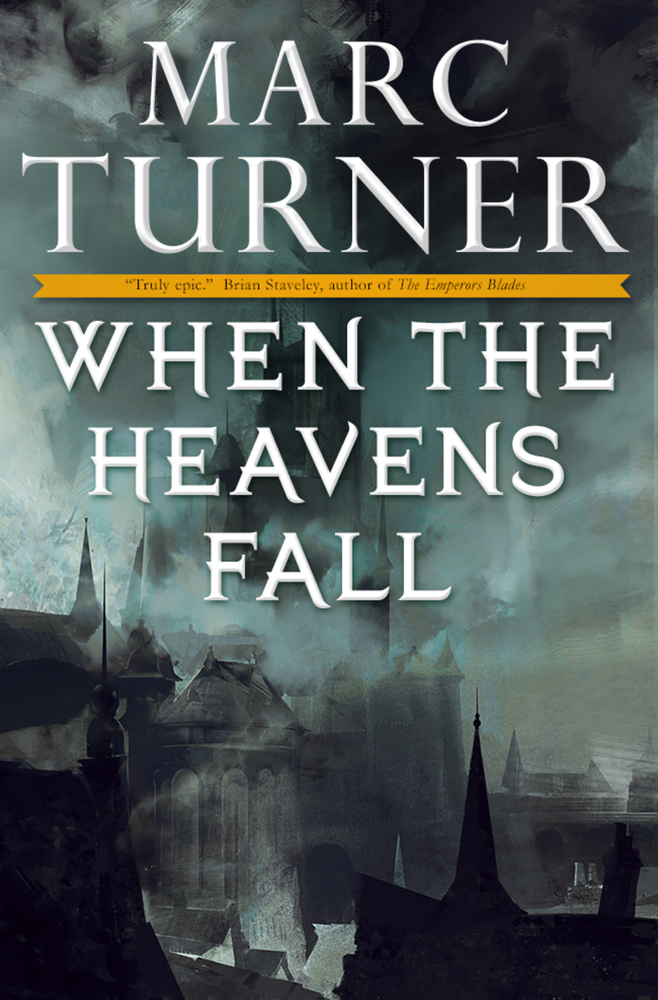
My debut novel, When the Heavens Fall, has been published for a few weeks now, so I’m becoming well acquainted with some of the ups and downs of being an author. In a strange way, the ups can also be considered downs and vice versa, sometimes even at the same time. Here’s what I mean by that.
That ‘first book feeling’
Up – There’s nothing quite like the feeling of seeing your book in a bookshop, particularly if you’ve had to wait a long time for the privilege. I’ve heard it said that the wheels of the publishing industry turn slowly. In my case they seemed to turn backwards on occasion. In total, the journey from writing my book to getting it published took ten years, but there’s no question it has been worth it. For a while writing was my hobby. It was what I did in the evening to escape from the day job. Now I get to see my book on the same shelves as some of my favourite authors such as Steven Erikson and Joe Abercrombie. And I dare to hope that my novel might mean as much to someone as the books that I read growing up meant to me.
Down – If there is a downside to that ‘first book feeling’, it is the sense that publication marks (hopefully) just the beginning of the journey, rather than the end. As an author, there is no resting on your laurels. I once read a sobering blog post by Myke Cole in which he said every novel is your debut. Every author is just one bad book away from the end of their career. I suspect George RR Martin or JK Rowling might get away with slipping in a bad one, but I understand the point. With an author’s second book comes expectation. There will be people out there thinking, “I loved your first book! It was great! Now DO IT AGAIN.” Or maybe even, “DO IT BETTER”. And you have to step up to the mark.
Writing is fun, right?
Up – One of the great things about being an author is that the job is as fun as you make it. If you’re working on something that’s not interesting, there’s a simple solution: make it interesting. It’s your book, you can cram in as much action, humour or tension as you like. And you should do too, because if you don’t find the writing enjoyable, you can’t expect your reader to either. There are times as a writer when inspiration seems to flow from your pen as readily as the ink does. You’ll reach your target number of words for the day and be happy with every one of them. If you’re especially lucky you might even have one of those Eureka! moments when you get an idea for a character or a plot point that brings the whole book together.
Down – Between the good days, though, there’s a lot of hard grind. I’ve never suffered from writer’s block, but there are times when the muse is gone for so long that I have to send out a search party. On other occasions I re-read what I’ve written and think my 6 year old must have bashing at the keyboard while I was out of the room. During those periods, you have to find a way to keep going. Editing in particular can be hard when the words just will not come together. I remember reading a book on writing craft that said you haven’t finished revising your manuscript until even looking at it makes you feel physically sick. That’s a sentiment I can sympathise with.
Use your imagination
Up – One of the things I like most about reading fantasy books is being able to lose myself in a new world. The experience as a writer is even more enjoyable, because you’re the one who does the inventing. For me, the best part of writing a book is dreaming up new places and stories. I can spend hours staring out of the window and letting my imagination roam, returning only from time to time to assure my wife that what I’m doing really is work. I love those maps that have “Here be dragons” or something similar on them to convey an area that is dangerous or unexplored. When I was planning When the Heavens Fall I wanted my whole world to be like that. If the characters step off the beaten highway, they never know what they’ll find. I don’t even know myself at times, but I always have fun finding out – usually at my characters’ expense. A fantasy world is limited only by the scope of a writer’s imagination.
Down – If there is a downside to this, it comes when as a writer you get asked the dreaded question, “So what’s your book about?” and you have to explain the plot to someone. There are plenty of people out there who don’t “get” fantasy. If I tell someone that the tagline of my book is “The Lord of the Rings meets World War Z,” I’ll receive a range of responses. At one extreme, the listener’s eyes light up and they want to know more. At the other extreme, a clump of tumbleweed blows past while the person looks desperately round for someone to save them from the conversation. It’s hard to describe the plot of a lot of fantasy books without making them sound silly. Try it with The Lord of the Rings. “So there are these little people with hairy feet and they have to throw a magic ring into a volcano to kill a Dark Lord.” You see the problem.
The “R” word
Up – It’s impossible to overstate the warm glow a debut author gets from a positive review. When a good review comes in I’ll read it over and over, maybe think about having it framed and mounted over the fireplace. Good reviews are so important when it comes to spreading the word about a book. In today’s packed fantasy market, it’s hard to stand out from the crowd. Mark Lawrence did a blog post a while back about the significance of reader recommendations. I’ll spare you his maths, but his conclusion was that a small difference in the number of recommendations can have a huge impact on a writer’s sales. And a review – or at least a good one – is a recommendation that has the potential to reach lots of readers.
Down – It’s easy to avoid getting bad reviews. All you have to do is write a book that appeals to everyone, everywhere. And how hard can that be? Back in the real world, authors accept that not everyone is going to like their book. Of course, that doesn’t stop a writer wanting them to, so a bad review will always hit below the belt. But you can respond to the review, right? You can point out all the ways in which the reviewer has got it wrong? No. Not ever. There’s simply no way you can do that and come out of it looking good.
Occasionally reviews aren’t even reviews in truth. Some people seem to think the star system is a way of complaining about a publisher’s prices, or a retailer’s delivery service – neither of which a writer has any control over. Sometimes it works in your favour. “5* – Book arrived on time and in good condition!” I’d take that. More often, though, it doesn’t. I remember Harlan Coben tweeting a review that stuck in my mind. It went, “1* – Never received it – Don’t think I ordered it.” A seasoned author might laugh at that, but a newcomer with only a handful of ratings might have to squint a little harder to see the funny side.
Independence vs Discipline
Up – Writers , like other self-employed people, are their own bosses. We have to do the work, but we get to decide how and when to do it. If we want to get up at noon and work until midnight, we can do. If we want to want to take our laptop outside and work in the garden, we can do that as well. And no commuting! No, I’m not gloating. Well, maybe just a little bit.
Down – Of course, the disadvantage to being able to get up at noon and spend the whole day on Twitter is that you might ACTUALLY get up at noon and spend the whole day on Twitter. Because if you do so, your deadline doesn’t get pushed back in turn. Or perhaps that should be deadlineS. Because among the other skills you’ll need as a writer is the ability to keep multiple plates spinning. You might be publicising one book while editing another and writing a third. And you need to accomplish all that when there’s no-one looking over your shoulder to make you do it.
Now, it’s about this time that some of you may be thinking, “So what?”. Poor little writer, did he find a hair floating round in his perfect job? And you’d be right. I’m not complaining. I’m certainly not looking for sympathy. Whenever the going gets tough, all I have to do is remember the job I was doing before I became an author and that quickly brings a fresh perspective. For me, the ups of being a writer will always be worth the downs.
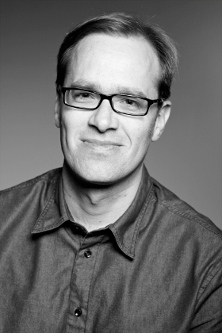 Marc Turner was born in Toronto, Canada, but grew up in England. He graduated from Lincoln College, Oxford University, in 1996 with a BA (Hons) in law, and subsequently joined a top ten law firm in the City of London. After realising that working there did not mix well with simple pleasures such as having a life, he fled north first to Leeds and then to Durham in search of a better work-life balance. Unfortunately it proved elusive, and so in 2007, rather than take the next step and move to Scotland, he began working part time so he could devote more time to his writing. Following the sale of his debut epic fantasy novel, When the Heavens Fall, he started writing full time.
Why writing? Because it is the only work he knows where daydreaming isn’t frowned upon, and because he has learned from bitter experience that he cannot not write.
The authors whose work has most influenced him are Steven Erikson and Joe Abercrombie. Consequently he writes fast-paced, multi-threaded novels with a liberal sprinkling of humour; novels written on a panoramic scale, peopled by characters that stay in the memory. Or at least that’s the theory . . .
He lives in Durham, England, with his wife and son.




Well said, Marc. I’m always cautious of stars, partly for the reasons you mentioned, but also because they’re so inconsistent. 3 stars can mean okay, good, great, or average depending on the site or platform.
As for every book always being your first, you’ve set the bar pretty high with When the Heavens Fall, but I’m confident the sequel will deliver. You captured a feel that drew me in, and that is probably the hardest part of writing. Anybody can come up with a plot and sketch out some characters, but you engaged my imagination and allowed me to get lost in the world.