In a day and age in which the element of mass communications is so prevalent in much of the world’s culture, reliable facts and genuine news have become a rarity. The public at large is at a loss for discerning between fact and fabrication. Several faked documentaries from the Discovery Channel as well as far-reaching biased informative publications are just a few examples of contributions to the misunderstandings.
A consumer or producer of modern media who searches for the truth needs to be able to discern between a reliable source and a non-reliable one. Both the consumer and the producer need to be cautious. Factors going into reliability evaluation include a producer or author’s credibility, clarity, and, to an extent, brevity in explaining facts.
But what has really agitated me is HISTORY’s programs of recent years which are based on science fiction! I love the idea of alien monsters, Star Fleet, the Death Star, and all that stuff, but its place is not on a “history” show. Ancient Aliens and its host Giorgio Tsoukalos have turned HISTORY into a joke, making every statement coming from the channel or its website unreliable.
Science fiction and science fact have long fueled each other, and there is a thin line between them. Scientists from over a hundred years ago, such as Percival Lowell, Thomas Dick, and William Herschel, began to consider the possibility of life in other parts of our galaxy; these ideas eventually gave birth to the early form of sci-fi culture. Ever since then, humanity has searched for the races of other worlds.

Physicist and author Alan Lightman in his book Time for the Stars (1992) says, “Extraterrestrial contact would forever change the way we view our place in the cosmos.” The scientist goes on to mention the very first modern quest for alien radio broadcasts, a program which was headed by Frank Drake at the National Radio Astronomy Observatory in Green Bank, WV. The search obviously did not succeed. But now we have people such as “ancient astronaut theorists” who apparently are still searching for the aliens, probably those same aliens that built the pyramids who lived a long time ago in a galaxy far, far away.
The “science fiction” genre was not called such until sometime in the 1930’s, or, according to James Gunn, until the year 1929. Early on, it was primarily writers and publications which produced science fiction stories. That legendary French author with extraordinary foresight, Jules Verne, referred to his books as “extraordinary voyages;” Herbert George Wells, the father of modern sci-fi, called his fictional works “stories of science” or “scientific romances.”
Clive Staples Lewis, author of the children’s fantasy novels about Narnia, seemed to have a distaste for Wells’ stories and wrote an entire sci-fi trilogy of his own. Lewis even started to write a fourth installment to his saga, The Dark Tower, which he was never able to complete. However, the modern movie of the same title as the unfinished novel is not associated with Lewis’s story.
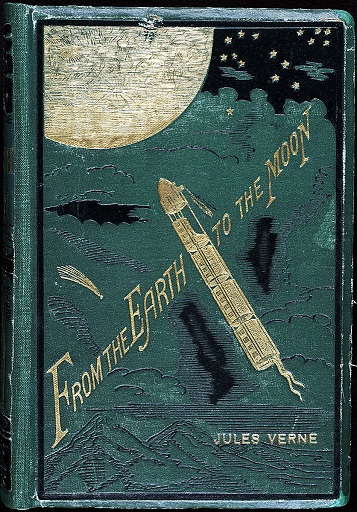
Jules Verne’s From the Earth to the Moon (1865), which was written over a hundred years prior to the first moon landing, inspired pioneering scientists like Konstantin Tsiolkovsky, Wernher von Braun, and Robert Goddard. Goddard went on to invent and experiment with fuel-projected rockets. He was also inspired by H.G. Wells’ The War of the Worlds (1898). When NASA sent the first men to the moon in 1969, Apollo 11’s command module was dubbed Columbia; the cannon which shot the vessel into space in From the Earth to the Moon was called Columbiad.
This wasn’t the only instance in which the National Aeronautics and Space Administration saluted a great work of science fiction from pop culture. In 1976, the first space shuttle, an experimental orbiter, was christened Enterprise after the USS Enterprise from Star Trek. And when the shuttle left the manufacturing plant it was greeted by several NASA officials, Gene Roddenberry (creator of Star Trek), and all of the main cast members from Star Trek: TOS except William Shatner who was absent.
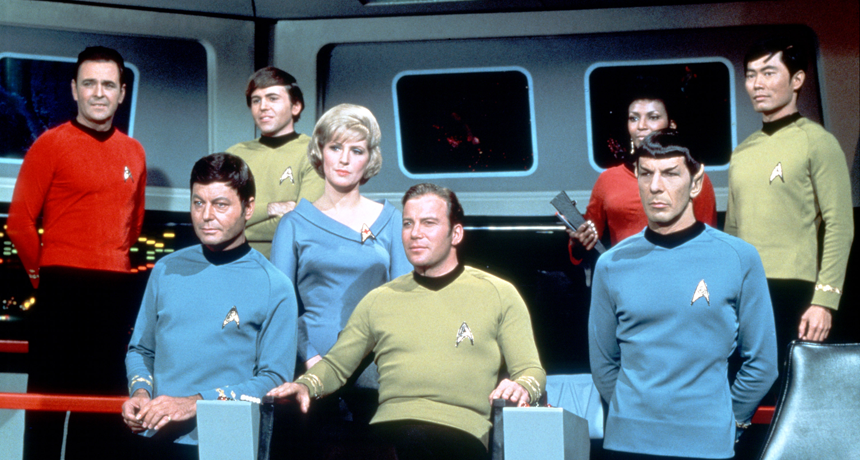
Award-winning astrophysicist Neil deGrasse Tyson often mentions Star Trek, and, of course, we all now know Gene Roddenberry was contacted by extraterrestrials. (I hope you can detect the sarcasm.) NASA also gave tribute to Star Wars. In 2007, a lightsaber prop from Return of the Jedi was carried aboard the Discovery shuttle.
As I have pointed out, science fiction has wriggled its way into the culture as well as genuine scientific endeavors, having either a positive, negative, or indifferent impact of scientific developments. Likewise, scientific research truly does fuel modern sci-fi plots for countless books and movies. But there is a time to set science fiction aside and discuss what we know.
The 1995 TV movie Alien Autopsy (Fact or Fiction) was conducted like a documentary and hosted by actor Jonathan Frakes, who had a main role in the Star Trek: TNG series. This production, like the Discovery Channel documentaries mentioned at the beginning of this article, was found out to be a hoax.
What really irks me about shows like Alien Autopsy and Ancient Aliens is that the whole premise for the informative program is based on hypothetical beings. A show like that has no business being on the History Channel. It is produced just because it will bring in ratings, whether what the theorists are spurting out is legitimate or not. Such entertainment takes advantage of viewers. An informative TV show should give its audience true, factual information. Ancient Aliens and similar series belong on Syfy if anywhere.
– John Tuttle