Presenting the decade retrospective from Andrew Leon Hudson, who edited a couple of the SFFWorld anthologies, Welcome to Pacific City and Ecotones.
Annihilation; Authority; Acceptance – the Southern Reach trilogy – Jeff Vandermeer (2014)

The first of Vandermeer’s excellent but obscurantist trio of weird, liminal novels might be the book that got me interested in eco-fiction, and as my picks of the decade will attest, that’s a genre which has gone on to have a big impact on my reading habits. Looking back five years to when I finished the trilogy, I have to confess that Annihilation is the one that has stayed with me the most fully; but though Acceptance is the one I feel I’d most need to revisit to fully appreciate the whole, it is the ironically job-titled “Control” of Authority who now calls most loudly to demand a reread of them all. The film made of the first book by Alex Garland back in 2018 was a very worthy adaptation too (although not entirely to my tastes in that mirror-figure departure from the original—unless I’m remembering it wrong…).
Europe in Autumn; Europe at Midnight; Europe in Winter; Europe at Dawn – The Fractured Europe Sequence – Dave Hutchinson (2014–18)

I was grabbed by Hutchinson’s near-future Europe right from page one. In many ways it takes a classic Cold War espionage format (secretive operatives traversing borders as they criss-cross a continent rife with rival nations) and then explodes it by postulating the collapse of the EU’s organised alliance into countless micro-states. With self-determination run riot in a way that England’s Brexiteering leadership would probably think sounds great (at least until the rest of creaking Britain shatters beneath their many left feet), enter a humble Estonian cook from a humble Polish restaurant who is gradually transformed into more than just an international smuggler for the mysterious Couriers de Bois—though exactly to whom his allegiances are owed, and what kinds of borders he will cross, are mysteries in their own right.
The Windup Girl – Paolo Bacigalupi (2010)

I liked The Windup Girl for how it reminded me of William Gibson’s Neuromancer without being remotely about the same things—at least, not on the surface. There is something simultaneously appealing and disturbing rising from the decay in Bacigalupi’s near-future Bangkok, its potentiality every bit as convincing as Gibson’s pan-USA Sprawl, but instead of digging into the dirt between gleaming digital spires we’re at the heart of a sweltering edge-of-starvation culture in which calories represent not just food but also currency and fuel. Gibson gives us cyberpunk, hacker heroes and augmented killers, and AIs straining at their cultural and evolutionary limitations; Bacigalupi gives us genepunk, compromised company men and law enforcers, and bioengineered semi-humans striving for equality. Both give us corruption, violence, and perspective-stretching ideas.
I Have Waited, and You Have Come – Martine McDonagh (2014)

The same year that Emily St. John Mandel’s celebrated post-apocalyptic drama Station Eleven was published, this less high-profile example of literary science fiction also came out. Set in the north of England in the wake of a minimally defined environmental disaster of rising sea levels and crumbling social norms, it presents pretty recognisable tropes and trials of the loner-survivor; but instead of the overtly aggressive predatory forces that so often populate our future wastelands, the adversaries in I Have Waited, and you Have Come are quieter, be they the psychological traumas and protective isolationism of the protagonist herself or the creeping proximity of her obsessive stalker. McDonagh explores these oppressions via a spare, personal narrative voice that draws the reader close while leaving you uncertain about which of these characters is doing the waiting, and which the coming.
Tropic of Kansas – Christopher Brown (2017)

I loved the title of this book at first sight, and Christopher Brown’s first novel turned out to be a whiplash-inducing mix of family drama and cross-country action-adventure that I gobbled up in a handful of consecutive nights before moving eagerly on to his follow up, the near-future legal thriller Rule of Capture. There are echoes of both The Windup Girl and Fractured Europe on display as Brown weaves a sociological and ecological nightmare as his setting, and Tropic of Kansas feels a bit like “Mad Max with politics”: a hot pursuit travelogue through a splintering United States, in which the environment is breaking down as fast as society and a populist despot wields the reins, crushing dissent or resistance via militarised domestic policy. Sound like anyone we know? Roll on 2024…
Too Like the Lightning – Ada Palmer (2016)

The opening salvo of the Terra Ingota quartet, in some ways Too Like the Lightning reminded me of Ann Leckie’s Ancillary Justice, published three years earlier. The conceptual leap is lesser here, but there are similarities of theme (protagonists with atrocity-stained pasts; civilisation-spanning conflicts that threaten revolution) and form (both books take interesting approaches to depicting gender and/or sexuality). Both are potent reads, but overall I found Palmer’s first novel a more satisfying, engaging experience than Leckie’s. I read Ancillary Justice the year it came out, but somehow never moved on to its sequels; I came late to Too Like the Lightning, only reading it this year, but I’ve already picked up books two and three, and am looking forward to adding the fourth when it is released in the coming year.
LIFE 3.0 – Being Human in the Age of Artificial Intelligence – Max Tegmark (2017)

I’m going to slip in what is actually a piece of non-fiction here, because it originally demanded my attention when I read a striking excerpt of it online: an engrossing pre-history of the effects on global society by the emergence of a genuine Artificial Intelligence. This introductory fiction provides much of the foundation upon which the arguments of the book to follow are based, either in exploring its enticing potentials or attacking its conceptual flaws, but that dose of fiction itself is such a good read, and other hypotheticals that arise during the back-and-forth of pro and con prove equally thought provoking, sometimes in ways that actual science fiction thrillers only hope of achieving. Whether you consider AI a pipe dream, an inevitability, or a complete unknown, there is lots to learn here.
Semiosis – Sue Burke (2018)
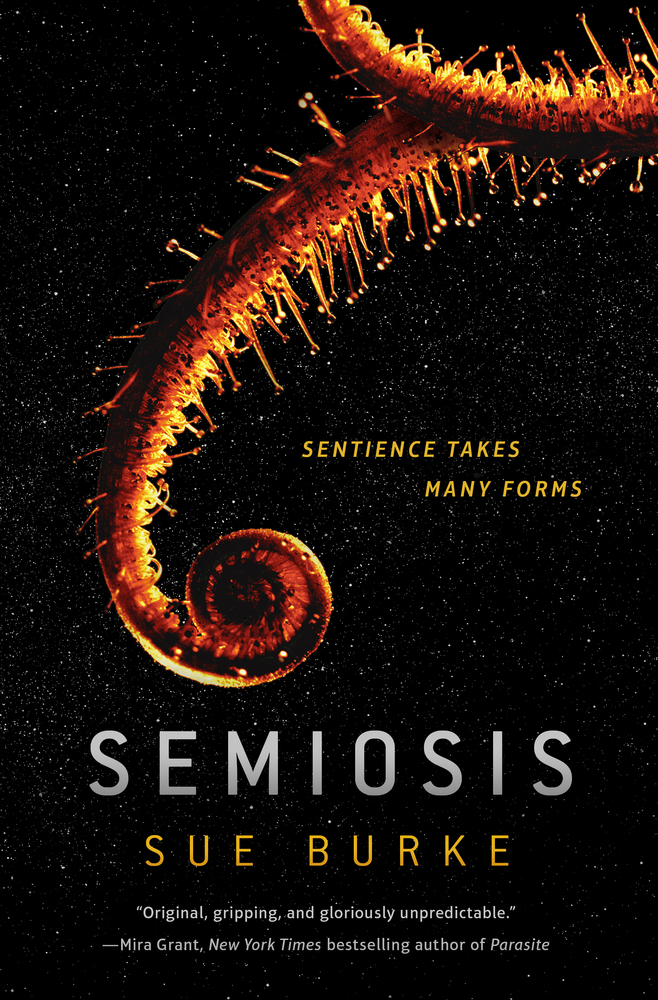
I choose to include Semiosis shamelessly, for the author is a friend, but also without shame because I think it’s a genuinely great science fiction novel. It starts in the classic vein of spacefaring first contact stories, with human colonisers delivered one-way from a far distant Earth to find themselves in a new home that, depending on circumstances, can be either welcoming and dangerous; what follows is a multi-generational epic in which as many threats arise from within the colony as without. There is another strong ecological hook here, this time regarding plant life as being not just a resource or obstacle to humanity but a source of sentience, and there are other alien perspectives waiting to join the conflict as well. Sue Burke had a long wait before seeing this novel published, but it was worth it. (Rob read and thought quite highly of this one, too!)
Green Earth – Kim Stanley Robinson (2015)

A bit of a cheat here, as this is the revised edition of the Science in the Capital trilogy, published between 2004 and 2007 as 40 Signs of Rain, 50 Degrees Below, and 60 Days and Counting—however, it’s the most impactful genre piece technically published in the last ten years that I’ve read. In this one-volume format, it comes across as Robinson intended: a single long narrative that walks the line between contemporary ecological thriller and cusp-of-the-future science fiction. I thought it was really something, not just for its colossal relevance and commentary on humanity’s dismal custodianship of the ecosphere, but (like Robinson’s Mars trilogy, the best thing I’ve read this millennium) because it is an excellent example of why “utopian” fiction has just as much capacity for drama and thrills as “dystopian” fiction does. The Mars trilogy was about the struggle to do amazing things. Green Earth is merely about the struggle to do the right ones.
BIO:
Andrew Leon Hudson is a technical writer by day, and is technically a writer by night as well. An Englishman based in Barcelona, Spain, in addition to his own writing he’s the editor of Mythaxis Magazine and a sometime co-editor of SFFWorld’s short fiction anthology series. You can very occasionally find him on his pseudonymous blog, Twitter, or lurking around the Writers corner of the SFFW forums.