
 Well, not quite. (Sorry!) But a recent discussion in the SFFWorld Forums, not to mention a certain recent news article, got me thinking about how important circuses and carnivals (evidently they are often regarded as the same thing) have been to Fantasy & SF fiction.
With that in mind, here’s a (no doubt) incomplete list of genre novels that may be worthy of your attention….
Science Fiction
To be fair, I thought that there would be more here in SF than I found. I’m sure I’ve read more about aliens kept in captivity…. Nevertheless, this was the most obvious one to my mind:
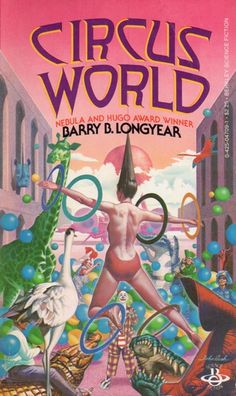
City of Baraboo (1980)/ Elephant Song (1982)/ Circus World (1980) by Barry B. Longyear
A trilogy of science-fiction stories based on a circus group who leave Earth to travel the stars. City of Baraboo & Circus World are both fix-up story collections. City of Baraboo deals mainly with the troupe leaving Earth. In Elephant Song the troupe are stranded off the beaten track on the planet Momus and have to cope with adversity. Circus World is a collection of seven stories based on the group’s re-ascendance from the planet Momus to interstellar fame and glory. Generally regarded as an intelligent series of tales with engaging characters, empathy and humour.
Dinosaur Summer by Greg Bear
One of my own personal faves – an alternate history romp, a tale that imagines that dinosaurs are not extinct but instead brought back from the wilderness and kept for entertainment in circuses. Also involves Ray Harryhausen…. Reviewed here at SFFWorld.
Fantasy
I’ve got to really start with the master of the creepy carnival, Mr Ray Bradbury. There’s a good reason that his first story collection was named Dark Carnival (1947). Bradbury was known for many memorable short stories, including his many short stories of freaks and marvels, as shown in collections such as Dark Carnival and The Illustrated Man (1951). Bradbury’s poetic and even nostalgic tone and style, centred on a determinedly American way of life, have been a huge influence on others such as Dean Koontz, Neil Gaiman and Stephen King (more on him later). Perhaps Bradbury’s novel Something Wicked This Way Comes (1962) is the epitome of his circus fiction: for Something Wicked This Way Comes tells of the arrival in Green Town, Illinois, of ‘Mister Dark’ and his sinister spectacle of the macabre. Bradbury himself though was allegedly impressed by:
The Circus of Doctor Lao (1935) by Charles G. Finney
A short but extremely odd, even melancholic tale of a Circus of Miracles upon its arrival in a small rural community town. It is filled with mythical and original creatures such as a satyr, a mermaid and a werewolf. The film version (The 7 Faces of Dr. Lao), adapted by Charles Beaumont, is also worth a watch, if you can find it these days, with a tour-de-force performance from The Odd Couple’s Tony Randall. The book is reviewed at SFFWorld here.
In the same way, the work of Charles Beaumont & Richard Matheson have often reflected their appreciation of Bradbury’s work. Beaumont is acknowledged as a friend of Bradbury’s. The duo’s work in the original Twilight Zone television series is well known.
The Story of Doctor Dolittle (1920) by Hugh Lofting
A childhood favourite for some, and made into a major box-office flop musical starring Rex Harrison in 1967 (and some awful Eddie Murphy vehicles between 1998-2003), it is a book that, despite its age, is widely remembered by many. Doctor Dolittle is a character who can actually talk to animals. These include Polynesia (a parrot), Gub-Gub (a pig), Jip (a dog), Dab-Dab (a duck), Chee-Chee (a monkey), Too-Too (an owl), the Pushmi-pullyu, and rather reflecting the age of the novel, a White Mouse later named simply “Whitey”. Charming, yet obviously a book of its time. Reflecting the original novel’s success and its popularity, there were eleven sequels published between 1920 and 1952.
The Night Circus (2011) by Erin Morgenstern
A more modern take on the creepy circus. Morgenstern’s debut novel was widely regarded as a great one, nominated for numerous awards in 2011. Its story is that of a circus in Victorian London that only exists in-between sunset and sunrise. It involves a wonderful sense of magic, in all its meanings, but mainly deals with a rivalry between two magicians, Prospero the Enchanter and Mr A. H. and their young protégés. Has a vivid sense of wonder combined with a distinctly dark side, which suggests a more modern and more violent updating of Bradbury’s visions.
The Troupe (2012) by Robert Jackson Bennett
And talking of dark, Bennett’s novel is perhaps the most recent version of Bradbury’s creepy circus, a tale of vaudeville combined with H P Lovecraft. Rob Bedford reviewed it here for SFFWorld.
Lord Valentine’s Castle (1980) by Robert Silverberg
Robert’s Vance-ian style Fantasy epic involved the amnesiac wanderer Valentine joining the circus as a juggler. By doing so both he and the reader were able to observe many of the strange places and weird aliens of the vast planet of Majipoor. One of my own personal favourites.
The idea of using the circus as a means of disguise is now an often-used one. See also Robert Jordan’s Wheel of Time series (1984-90), where travelling in a circus was often a means of camouflage. Similar things happened to Cithrin bel Sarcour in Daniel Abraham’s Dagger & the Coin series (2011 – 2016), to Kirsten Raymonde in Station Eleven (2014) by Emily St. John Mandel (reviewed here), and even Stardust (1998) by Neil Gaiman.
Horror
For those wanting their circus entertainment a bit more on the scary side, how about:
Nights at the Circus (1974) by Angela Carter
A magical realism tale combined with the trappings of a fairy tale, the story tells of Sophie Fevvers, a circus act who has literally grown wings. Sophie is a character whose tale is told whilst Colonel Kearney’s circus is on a Grand Imperial Tour from London to Petersburg and then Siberia. Like much of Carter’s work, a romantic, yet determinedly adult tale of sexuality and sleaze, showing us the grimmer side of circus life.
IT by Stephen King (1986);
Though not directly about circuses, King’s character of Pennywise dressed as a clown has become iconic as a person of entertainment turned evil. “We all float down here….” *shudder*. Though I was disappointed by parts of the book (I loved the book, up to the ending) there is no doubt that Pennywise is known by many, even those who have not read the book or seen the 1990 TV mini-series.
The Pilo Family Circus (2006) by Will Elliott seems to have a similar tone, telling of Jamie, who after a random incident of nearly hitting a clown with his car, finds himself being stalked by three sadistic clowns. This leads to Jamie entering into the horrific alternate universe that is the centuries-old Pilo Family Circus, a borderline world between Hell and Earth from which humankind’s greatest tragedies have been perpetrated. There was a sequel, The Pilo Travelling Show, published in 2015.
See also books like Dean Koontz’s The Funhouse (1980), a novelisation of a movie screenplay that was published before the movie was released, and Richard Laymon’s Funland (1990) both of which show fun fairs as eerie places, where bad things happen in the dark. It’s a strong image – even Stephen King had funfairs in some of his other novels, such as in the beginning to The Talisman (1984) near the Alhambra Hotel and in Joyland (2013) where in 1973 Devin Jones works away his summer (reviewed here).
More recent excursions:
Pantomime by Laura Lam (2013)
Originally published in 2013 and recently re-edited and republished, the books in this trilogy (Pantomime, Shadowplay and Masquerade, (2013 – 2017)) deal with a lead character who is intersex. To quote the publicity, “Gene’s life resembles a debutante’s dream. Yet she hides a secret that would see her shunned by the nobility. Gene is both male and female. Then she displays unwanted magical abilities – last seen in mysterious beings from an almost-forgotten age. Matters escalate further when her parents plan a devastating betrayal, so she flees home, dressed as a boy.
The city beyond contains glowing glass relics from a lost civilization. They call to her, but she wants freedom not mysteries. So, reinvented as ‘Micah Grey’, Gene joins the circus. As an aerialist, she discovers the joy of flight – but the circus has a dark side. She’s also plagued by visions foretelling danger. A storm is howling in from the past, but will she heed its roar?”
Caraval by Stephanie Garber
Most recently, (March 2017), Caraval is a book that shows that the importance of circus has not gone away. It appears to be similar in tone and style to The Night Circus. From the publicity: “Scarlett has never left the tiny isle of Trisda, pining from afar for the wonder of Caraval, a once-a-year week-long performance where the audience participates in the show.
Caraval is Magic. Mystery. Adventure. And for Scarlett and her beloved sister Tella it represents freedom and an escape from their ruthless, abusive father.
When the sisters’ long-awaited invitations to Caraval finally arrive, it seems their dreams have come true. But no sooner have they arrived than Tella vanishes, kidnapped by the show’s mastermind organiser, Legend.
Scarlett has been told that everything that happens during Caraval is only an elaborate performance. But nonetheless she quickly becomes enmeshed in a dangerous game of love, magic and heartbreak. And real or not, she must find Tella before the game is over, and her sister disappears forever.”
Collections: And lastly, though I’ve not personally read this one, if I’ve piqued your interest with the above, it sounds like it might be worth a look: Circus: Fantasy under the Big Top, (2012) edited by Ekaterina Sedia, with stories by Ken Scholes, Peter Straub, Genevieve Valentine, Jeff Vandermeer and others.
So: what have I missed? What short stories should be included? (We’ve already had mentioned in the Forums Robert Heinlein’s story The Man Who Travelled in Elephants, for example. How about Rod Serling’s scary story about a possessed manikin, made so memorably into the Twilight Zone episode The Dummy (1962), or even the version written as a screenplay by John Baines in the movie Dead of Night (1946) with the ventriloquist played by stalwart British actor Michael Redgrave? Or William Goldman’s novel and screenplay for the movie Magic (1978) starring Anthony Hopkins? I’m sure there’s more – feel free to let us know in the Comments or in the SFFWorld Forums of any blindingly obvious gems I happened to have missed…
Farewell, Ringling Bros!



Small correction: Longyear’s first book is City of Baraboo.
And thanks, Joann – gratefully corrected. (See… circuses on the brain!)
Mark
I seem to remember there was a section involving circuses and/or carnivals (he refers to the participants as ‘carnie folk’) in Robert Heinlein’s Stranger in a Strange Land. It’s many years since I read it, so my memory is a bit hazy, but I’m fairly sure he was trying to put over the idea that those same carnie folk are more genuine than ‘normal’ people despite looking, and sometimes being, different – well, that’s how it came over to my brother and I.
Ah, Dead of Night and the creepy ventriloquist dummy.
Along a similar vein would be Christopher Stasheff’s “Starship Troupers”, about a company of actors who decide to take their productions not only off-Broadway, but off-planet as well.
Thanks Helen & expendable!
Must admit, I can’t remember that about Stranger, but it’s been a while. It wouldn’t surprise me, though: Heinlein was very keen on the arts & theatre – Double Star, of course, involved an actor playing a role.
And thanks also for the information about the Stasheff book: I know him from his humorous Warlock series. I guess the pun title of the one you’ve suggested should be a giveaway!