 If we accept that novels are always about something, we could accept that in the main they are about choices – ethical, moral, social and cultural dilemmas. Being able to choose is what gives us our sense of morality. Traditionally that morality has been pitched in terms of good and evil, a circumstance regrettably still underpinning our cultural world in the West, but I think the time is upon us now – largely due to the demise of religion – in which we look elsewhere for a moral compass. Some look to atheism and humanism, some to the internet, others to a melange of old spiritual ideas. Good and evil are old-style extremes: black and white. Yet humanity is grey.
In my new Conjuror Girl trilogy I wanted to look inside us to answer the question: what better way is there of describing moral choices? As I have believed for most of my life, humanity and inhumanity is the key, and, in the case of this new trilogy, specifically narcissism – selfishness. The main character, Monique (later Monica), alongside her best friend Lily, finds herself in a situation in which a very bad man has power over her, a situation worsened by her discovery of a special talent within her, something only men are supposed to have. This sets up her dilemma. The man – Mr Goldgate, ruler of Shrobbesbury Orphanage where she lives – is cruel, domineering, callous and utterly selfish. What should her response be to his lack of humanity?
Mr Goldgate in this trilogy is my Darth Vader, my Sauron. Yet even though he’s a dark character, an irredeemable character, he still needs to be understood. This is one of the problems I have with standard evil folk in genre novels – there’s no analysing them. Evil, as it’s generally understood, is something in itself which does not need to be analysed and comprehended. As such though, it’s a pretty useless concept – as is pure good.
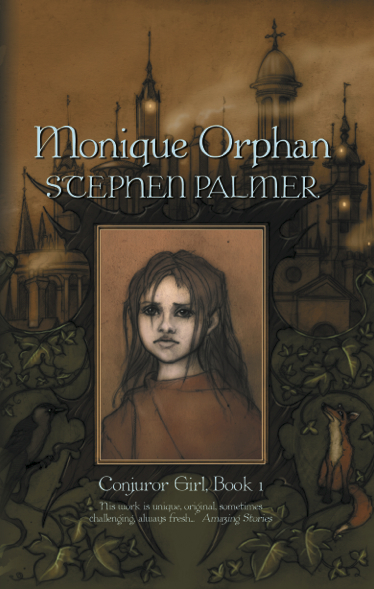 Monique duels with Mr Goldgate in her own inimitable way, and in doing so comes to differentiate between revenge and justice. These are quite advanced concepts, but I like merging such things with younger characters (as does an influence of mine, Philip Pullman), so it was always part of the thematic set-up. In the end Monique comes to understand Mr Goldgate through the characteristics of selfishness, which she observes in others – particularly Lily – and then, via others, in herself. It’s this vision of herself from the perspective of others which is her saving grace. Mr Goldgate, she realises, can never do such a thing. He’s not only too far gone, he’s influenced and supported by his kin, who have the same selfishness. Mr Goldgate can never see himself from the perspective of others. His understanding of the world is not true to the world, it is an imaginary construct, a state of affairs conducive to domination, control, cruelty, and indeed to all the other inhumane traits exhibited by people unable to feel empathy for others.
This, in fact, is the heart of Mr Goldgate’s inhumanity. He’s not evil, he’s inhumane because he’s never progressed beyond the boy’s view of the world, which means placing himself at the centre of it. Though he grasps that other people exist around him, he perceives them and interacts with them as though they were phantasms created by his own mind – aspects of himself. He doesn’t understand that they are independent of himself, just as he doesn’t understand that the real world also has that quality. No wonder he has a huge painting of Narcissus on his study wall.
What, then, of vengeance and justice? Monique feels a strong urge to revenge herself on Mr Goldgate for what she preceives as his crimes, but as the book progresses she starts to finesse the difference between vengeance and justice. Of course, there are sections of society who see part of the legal consequence of crime to be punishment: prison, even death. To my mind those are juvenile responses. There is a far greater weight of evidence showing humane treatment (rehabilitation) to be more effective and better for society than there is for imprisoning or killing criminals. Moreover, much evidence exists now to show the value of criminals undertaking contact with their victims in order for them to feel guilt, even empathy. And that’s what it’s all about: empathy.
We diminish ourselves by resorting to concepts like good and evil. Those black-and-white notions should be consigned to the dustbin of history. They had their time, when humanity was putting its early moral code together, but that time has passed.
All praise to grey.